Human agency is lost in the fall (which remains an inexplicable thing). The only hope for human agency to be reestablished before God is for God to re-create it as  He has for us in the human agency of the Second and Greater Adam, who is the Christ. This is one reason people of a certain ilk reject the notion of a natural theology, and its subset in the anologis entis (analogy of being). Hence, knowledge of God is a purely Graced reality, and not a natural one in any way. I am, in fact, of said ilk (shocking!) I will always find it shocking the self-professed Reformed orthodox and Lutheran orthodox folks affirm natural theology as the fundamentum of their theological projects. Don’t you see why? These forlorn Protestantisms claim to hold to a radical form of Total Depravity, wherein what it means to be human, in a fallen sense, is to be so polluted by and riddled with sin, that ostensibly the ontic capacity, along with its noetic counterpart, cannot and will not come to know the true and the living God.
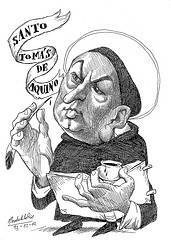
And yet I would suggest these Protestantisms are held within a Thomistic Captivity. That is, for them, as with Aquinas, what it means to be God, and then as corollary, what it means to be human, is to constantly have a resident and active intellect at play. And for the creature, even postlapsarian, this entails that the intellect, at the very least, retains its spark of being. That is, in order for the integrity of God’s being to be upheld, for those in the Thomist Captivity, human being’s intellect must be upheld even post-fall. As Steven Ozment so eloquently describes this chain of being for Thomas and his children:
The assumption that real relations existed between God, man, and the world made possible Aquinas’s confidence in a posteriori proofs of God’s existence; finite effects led necessarily to their origin, because they were really connected with it. The same assumption underlay Aquinas’s distinctive views on the “analogical” character of human knowledge and discourse about God. According to Aquinas, one could speak meaningfully of one’s relationship to God by analogy with one’s relationship with one’s fellow man because a real relationship existed between the values of people shared and those God had prescribed.[1]
With Thomas, for me, it isn’t the idea “that real relations existed between God, man . . . ,” I am a critical/theological realist after all. The problem in the Thomistic frame is that the ‘point of contact’ between God and man, the point of relation, is predicated by a chain-like continuity between God’s intellect and humanity’s (intact, at whatever level postlapse). But the Bible teaches otherwise in regard to the effects of the fall, on both the world simpliciter, and humanity.
I submit, that in order for humanity to come to have a genuine knowledge of the triune God, that the triune God must become us that we might become Him by grace. Without this participatio Christi all the human can do, even in the name of Christ, is construct monuments of their own intellects and worship them as God. This is why I reject the premises of a natural theology; and this is why I would recommend that you do the same.
[1] Steven Ozment, The Age of Reform 1250–1550: An Intellectual and Religious History of Late Medieval and Reformation Europe (New Haven and London: Yale University Press, 1980), 49.