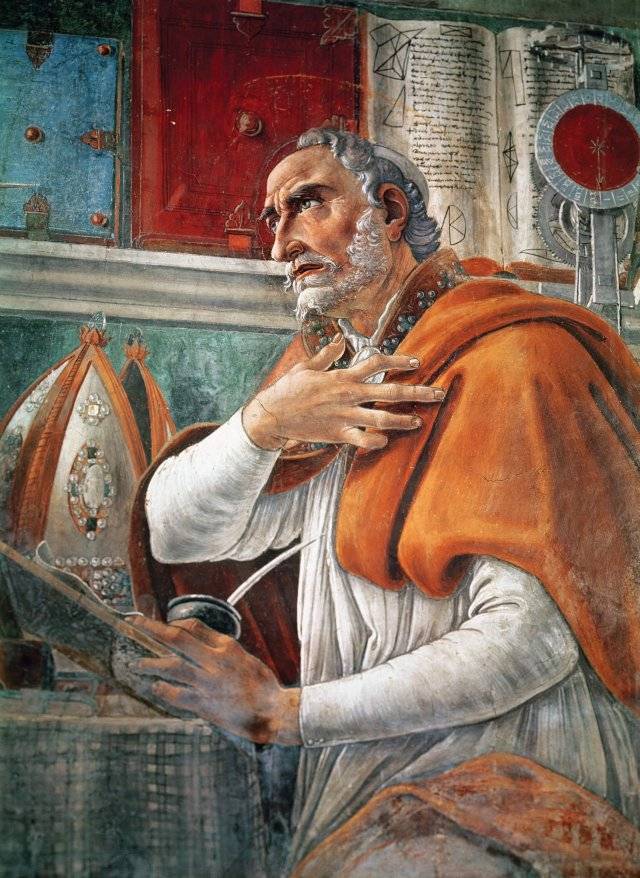
TF Torrance often refers to what he calls ‘The Latin Heresy,’ when discussing Western theology; especially with reference to its fountainhead, Augustine. The Latin Heresy for TFT entails the neo-Platonist dualism that funds Augustine’s theology, and all other theologies that follow Augustine’s categories. For TFT, this dualism involves a competitive relationship between God and humanity; such that, humanity is thought in abstraction relative to God’s life, rather than finding its concrete ground therein. This shows up most clearly in Augustine’s doctrine of election. JND Kelly masterfully describes this,
The problem of predestination has so far only been hinted at. Since grace takes the initiative and apart from it all men form a massa damnata, it is for God to determine which shall receive grace and which shall not. This He has done, Augustine believes on the basis of Scripture, from all eternity. The number of the elect is strictly limited, being neither more nor less than is required to replace the fallen angels. Hence he has to twist the text ‘God wills all men to be saved’ (1 Tim. 2, 4), making it mean that He wills the salvation of all the elect, among whom men of every race and type are represented. God’s choice of those to whom grace is to be given in no way depends on His foreknowledge of their future merits, for whatever good deeds they will do will themselves be the fruit of grace. In so far as His foreknowledge is involved, what He foreknows is what He Himself is going to do. Then how does God decide to justify this man rather than that? There can in the end be no answer to this agonizing question. God has mercy on those whom He wishes to save, and justifies them; He hardens those upon whom He does not wish to have mercy, not offering them grace in conditions in which they are likely to accept it. If this looks like favouritism, we should remember that all are in any case justly condemned, and that if God makes His decision in the light of ‘a secret and, to human calculation, inscrutable justice’. Augustine is therefore prepared to speak of certain people as being predestined to eternal death and damnation; they may include, apparently, decent Christians who have been called and baptized, but to whom the grace of perseverance has not been given. More often, however, he speaks of the predestination of the saints which consists in ‘God’s foreknowledge and preparation of the benefits by which those who are to be delivered are most assuredly delivered’. These alone have the grace of perseverance, and even before they are born they are sons of God and cannot perish.[1]
As Kelly describes Augustine’s doctrine of predestination, election-reprobation, what stands out is the way God stands over humanity, as if humanity has no correspondence to God by God’s grace. As if humanity must find a way to God, even as God finds His way to humanity. And for Augustine God only finds His way to humanity through an ad hoc arbitrary election of certain individuals, who he snares out of the ‘massa damnata’ (the ‘mass of damnation’ of humanity). But it is this that represents the inorganic notion of a God-human/God-world relation for Augustine; i.e., that humanity has no ground in God’s life organically, creatively; that it is only by God’s voluntary act that He brings ‘some’ into a contractive relationship with Him—as some would call it later, the absolutum decretum (the absolute decree of election/reprobation/predestination).
So, all of the aforementioned to bring up another application of this type of Augustinianism as it relates to soteriology. In Book 4 of Peter Lombard’s infamous Sentences, he writes the following:
Chapter 2 (110)
- CONCERNING THOSE WHO DO NOT COMPLETE THEIR PENANCE. But if it is asked whether those who do not complete their penance in this life will pass through the fire to complete there, as it were, what they have left unfinished here, we say that the same is to be supposed concerning these as of those who repent at the end.—For if their contrition of heart and their disapproval of crime were so great as to suffice for the punishment of sin, they will pass into [eternal] life free from other punishments, even if their penance was not completed, because they perfectly repented and groaned in their heart.—But as for those who are not so contrite in heart, or who do not so groan for sin, if they died before the completion of penance, they feel the purging fire, and are punished more gravely than if they had completed their penance here, for it is an awful thing to fall into the hands of the living God.
- For since God is merciful and just, he forgives the penitent from mercy, not reserving the sin for eternal punishment; but from justice, he does not leave a crime unpunished. Either man punishes it, or God. Man punishes it by repenting. And penance is inward and outward. And so, if the inner sorrow is such as to suffice as retribution for sin, God, who knows this, does not exact any further punishment from someone who repents in such fashion. But if the inward sorrow does not suffice as retribution for sin, and the external penance is not fulfilled, God, who knows the ways and measures of sins and punishments, adds a sufficient punishment.
- “Let each one, then, see to it that he so corrects his crimes, that it will not be necessary to sustain a punishment after death. For some mortal sins become venial in penance, but are not immediately healed. Often a sick person would die, if he were not given medication; but he is not healed as soon as he receives medication: he who is going to live languishes, who before was about to die. But one who dies impenitent, dies wholly, and is tormented eternally. For if he were to live forever, he would sin forever.”[2]
The above longform to simply point out one simple, but profound reality: if humanity is not thought from God’s grace for us in His hypostasized life for us in the person of Jesus Christ; if humanity is not from God’s unilateral givenness for us in His election to be for all of humanity, indeed as He assumes all of humanity into His vicarious humanity pro nobis (for us) in Jesus Christ; then, humanity will always be left destitute, even ‘elect’ humanity, not to mention the mass of humanity who God does not elect, to pursue God and fill up the gap between God and humanity through the various means of grace God has given them. The dualism, if not obvious, is present in the penitential theology of Augustine, and the Latins, both on the Catholic and Protestant sides, insofar that the human being must constantly strive, and constantly reach out and hope that ‘they’ have done enough to be found worthy before God; even in the supplicant of His freely given grace. Grace in this frame becomes detached from God’s personal and triune life in Christ for the world, and instead it becomes a created grace, a quality, that the elect (they hope they are) must rightly habituate in and handle in the right ways if they ever hope of being in the Beatific Vision, and maybe, just maybe getting to avoid the ‘purging fires’ (Purgatory) along the way.
It ought to be clear though, in a soteriological frame, how Augustine’s “individualistic” understanding, as detailed by Kelly, and illustrated by Lombard in an Augustinian penitential theology, throws the would-be elect individual upon themselves, rather than upon Christ, in their pursuit of salvation and eternal life, coram Deo. God forbid this! God has singularly brought Godself and humanity together in His pre-destination, within His own life, in His elected elect humanity in the eternal Logos, the Son of God, as He hypostatically united His divine life with our human life, in His assumptio carnis (‘assumption of the flesh’), and made His human life our life, as we rose from the dead with His humanity, which is total humanity, by which all of humanity has been objectively saved (note: this does not entail a universalism, per se).
[1] J.N.D. Kelly, Early Christian Doctrines, Revised Edition (New York: Harper Collins, 1978), 368-69.
[2] Peter Lombard, The Sentences: Book 4, On the Doctrine of the Signs, translated by Giulio Silano (Toronto-Ontario Canada: Pontifical Institute of Medieval Studies, 2010), 122–3.