The evangelical churches in North America, in particular, and in the West, in general, have largely been secularized. To say something has been secularized has broad affect. But primarily, I am wanting to emphasize how pagan Enlightenment categories have been uncritically swallowed by the churches. Whether that be to affirm climate change (as “creation care” or ecotheology), softness on Lesbian-Gay-Bisexual-Transgender-Queer-Intersex (i.e., “gay Christians”) issues, critical theory and critical race theory, Liberation theology, and a whole host of other antisupranaturalistic Enlightenment categories and ideologies, the evangelical churches, by and large, have allowed themselves to be defined by. And if the culture, as the Apostle Paul and the Holy Spirit identify for us, is in fact an ‘evil age,’ then what in God’s Holy Name hath this darkness to do with the Light? As Christians, as ambassadors, as emissaries of Jesus Christ we have been called to bear witness to Jesus Christ, and by this witness, by His reality, His resurrection power indwelling us, indeed as we participate in His life by the Spirit, by His Light we are to expose the darkness; which would entail, that we, on the other hand, repudiate the secularism, the paganism, the Enlightenmentism that so many of the evangelical churches are in fact imbibing (even in the name of Jesus Christ as “bridge-building” aka thirdwayism).
Conversely, the aforementioned has a history. The formative parts of that history are present within the 17th and 18th centuries (so, the Enlightenment). This was a time when the empiricism and rationalism of someone like John Locke, the rationalistic dualism of Immanuel Kant, the Deism of the like et al. was in full blossom. The Deists, of course, simply believed that there was a transcendent god, up there yonder, who got everything started, who created the heavens and earth, gave it a good spin, and has since left it to itself; and to us. Embedded in Deism was a charred rationalism, that when applied to the confessional Dogmas of the historic church, with particular focus on the doctrine of the triune God, left God almost dead in the gutter; left a God, as noted, who was most assuredly not three-in-one / one-in-three. As such, being a confessional Christian—someone who affirmed the orthodox ecumenical church creeds of Nicaea, Constantinople, Chalcedon, with reference to the triunity of God and the deity of Christ—had come to wane. In the face of the intelligentsia of that day and hour, to be a confessional Christian was looked at like being the village idiot or something. Even so, and by the mercy of God, such persons persisted.
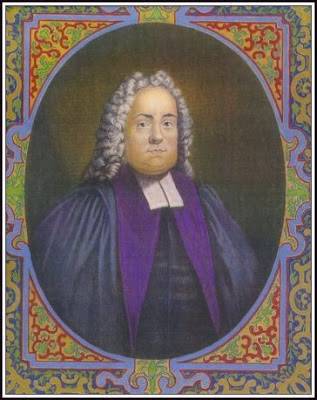
In the midst of this, those “persistents,” the people who withstood succumbing to the Deists and rationalists among them, within the “churches,” remained faithful to the reality of the triune God. Indeed, here is how contemporary church historian, Nick Needham, writes about one of these ‘faithful,’ with direct reference to Matthew Henry himself:
For the Dissenters, Presbyterian Matthew Henry (1662–1714, author of the famous Bible commentary, spoke in a similar vein as the 18th Century began:
The low condition of the church of God ought to be greatly lamented; the Protestant interest small, very small; a decay of piety; attempts for reformation ineffectual. Help, Lord! There are but few who are truly religious; who believe the report of the Gospel, and who are willing to take the pains, and run the hazards of religion. Many make a fair show in the flesh, but few only walk closely with God. Where is he that engageth his heart, or that stirs up himself to take hold of his Maker?[1]
The way Henry was referring to his time and day in the churches sounds eerily similar to our day and time. More than ever, so-called evangelical Christians, particularly “the leaders,” have allowed the erosive powers of the current world culture[s] to seep into the churches; and they have done this all in the name of Jesus Christ. There are many who use the name of Jesus Christ, refer to the Bible, use all the right Christianese, and yet they have in point of fact denied the power of God, the Gospel, in favor of cloistering with the various secular ideologies run amok among us in this world system. These ‘forces,’ within the churches, particularly as we see that given expression in a magazine like Christianity Today, or in the writings and activities of the late, Tim Keller’s thirdwayism (acquiescing to the progressive ideologies of the 21st century), in the name of bridge-building, or in the “winsomeness” of someone like Russell Moore or J. D. Greear, have taken the many peoples of the churches into the slough of despondency, right along with them. This shan’t remain the case!
Like in Henry’s day, it is easy, and at a point, even appropriate to bewail the current church situation. But we cannot stay in that status. The ‘faithful’ must recognize our current moment, as that has been foisted upon us, even by us, and first and foremost repent. Once this step has been taken it is incumbent on each and everyone of us, indeed as individual members of the church, to keep in step with the Holy Spirit, take up our crosses daily, and follow Jesus Christ. As we live out our unique callings by our Master, as we shine brightly with the Brightness of our Lord and Savior, Jesus Christ, as we expose the darkness with the Light of Christ, we might be able, yet, to inject the churches, the church, with the vitality of our risen and ascended Lord. That can only come as we participate in the life of Christ, in union with Him, and by His resurrection and ascension energy, in shared koinonia (fellowship), one with the other, by which the power of God, the Gospel, can come to have full effect on the liveliness of the churches, and as the light to the world that Jesus is Savior and Lord.
[1] Nick Needham, 2000 Years of Christ’s Power: Volume 5: The Age of Enlightenment and Awakening (Great Britain: Christian Focus Publications, 2023), 99.