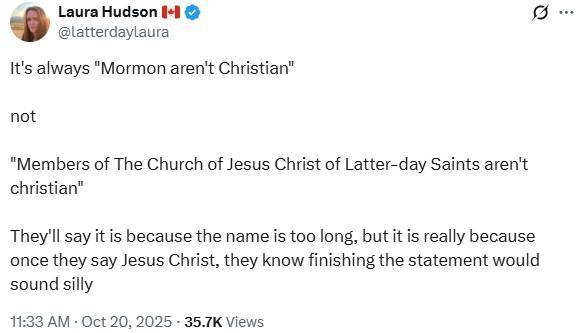
More engagement with a Mormon (a different one this time).
On Mormonism as a Form of Gnostic Arianism
No, it’s because the Mormon Jesus is equivocal with the Christian Jesus. In other words, the Mormon Jesus is not understood to be the second person of the Trinity (along with the Father and Holy Spirit), i.e., not ℎ𝑜𝑚𝑜𝑜𝑢𝑠𝑖𝑜𝑠 (of the same exact being) with the Father and the Holy Spirit. The Mormon Jesus, at best, is a philosophical demiurge deployed by the Father (who alone is God) to point the LDS to their inherent need to be freed from the physical body and become “Father-Gods” themselves (with a harem of celestial wives … which I would imagine you’re aspiring towards). In the primitive church what Mormons present the world today with is what was known as Gnosticism (and a form of Arianism in regard to the Son) then. Yes, none of this is original to Joseph Smith or Brigham Young (barring their own respective historical idiosyncrasies and lack of intellectual sophistication).
In the end, the Mormon would do well to heed the Patristic theologian’s, Athanasius’, words against the Gnostic and Arian understanding of salvation and Godself, as he writes: “Therefore it is more pious and more accurate to signify God from the Son and call Him Father, than to name Him from His works only and call Him Unoriginate.” (Athanasius, 𝐶𝑜𝑛𝑡𝑟𝑎 𝐴𝑟𝑖𝑎𝑛𝑜𝑠 1.9.34.)
On Mormon Deification and Theosis
Mormon notions of deification have zero correspondence with Christian and or Patristic (early church) thinking on deification. The LDS appeals to language like deification, but they do so only under the pressures of their own doctrine of ‘Godhead.’ The Christian notion of deification is purely grounded in the Christian God’s theopoiesis for us. This entails the notion that it required God to ‘become us that we might by grace and adoption [not nature] become Him,’ that is, that He freely became us in the grace of Christ’s life that we might by the faith of Christ by the Holy Spirit, come into spiritual union with Christ’s resurrected humanity, thereby becoming adoptees of God, and thus become participant in the triune life of God; indeed, just as the Son, in the bosom of the Father, has always been in the glory of the Father as the Father has been in the glory of the Son by the bonding glory of the Holy Spirit (one in three / three in one), see John 17. Since Mormons reject the Nicene (biblical) doctrine of the Trinity, they can only hope to be like their exemplar, Jesus (a creature, spirit-brother of Lucifer, in their view), and attain a life-like Father-God in the eschaton someday (where the man can have their own planet with a celestial harem, populating their respective planets with celestial children had by their celestial wives, just as the Father-God now did with Mary by birthing Jesus::they downplay this though). And this, based on their climbing a ladder of knowledge (so, thematically, Gnostic-like), which they identify as ‘covenant-keeping’ (which of course is based on their own striving, not grace as understood Christianly). Ultimately, for Christians, historically we do not believe that we become gods, instead we believe that we become fully human in the 𝑇ℎ𝑒𝑎𝑛𝑡ℎ𝑟𝑜𝑝𝑜𝑠 (Godman) humanity of Jesus Christ; who alone is God for us, and brings us into His Sonship (not by nature but grace) by which, as adopted children of the Father, as it were, within the triune Monarxia, we live in the beatific vision of the Godhead. That is, we inhabit the triune God’s inner-life, in all the mystery that entails; which sounds like Heaven to me.
So, when a Mormon appeals to ‘deification,’ which is a contested term itself in the history of orthodox Christian interpretation, it has zero correspondence with the Christian teaching on deification or theopoiesis. The Mormon holds to a doctrine of godness wherein the hope, through knowledge attainment (i.e., covenant keeping), is that the men, again, will become exalted Gods themselves; just as the Father is now (in their schemata). They try to downplay discussion about ultimate or eschatological things because they know it sounds strange, and thus ends up exposing the disparity there is between their respective understanding of Jesus, Father-God, the Holy Spirit and eternal life vis a vis actual Christian doctrine; not to mention with the contextual biblical teaching itself.