Category: Evangelical Calvinist
Writings from the blog: Athanasian Reformed (aka The Evangelical Calvinist). Senior Reformed scholars present a coherent and impassioned articulation of Calvinism for today’s world.

A Psalm for the Dark Night
Where is God? Why doesn’t he care? Why does he let me go through these dark shadows of existence? There is a deep waning in what appears to be his absence. As if ‘greater are the circumstances of life, than he who is at the right hand of the Father.’ This is what the serpent whispers into the ear-gate as I continue to sputter in what seems to be the darkness of the abyss. Where are you, O Lord? Why have you abandoned me? It seems like your cross, rather than bringing light, only brings darkness in the torment of…
‘Always Reforming’
All Christian theology, 𝑑𝑒 𝑗𝑢𝑟𝑒, is eschatological. This is what makes space for 𝑒𝑐𝑐𝑙𝑒𝑠𝑖𝑎 𝑟𝑒𝑓𝑜𝑟𝑚𝑎𝑡𝑎, 𝑠𝑒𝑚𝑝𝑒𝑟 𝑟𝑒𝑓𝑜𝑟𝑚𝑎𝑛𝑑𝑎 𝑠𝑒𝑐𝑢𝑛𝑑𝑢𝑚 𝑣𝑒𝑟𝑏𝑖 𝑑𝑒𝑖 (“reformed and always being reformed according to the Word of God”). Selah Athanasian Reformed
Are You a Pietist; Am I? Who is First, God or the Humans?
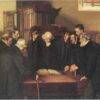
The Pietists, 1898. Creator: Venny Soldan-Brofeldt A few years ago, I was at a regional ETS theology conference. A theologian friend of mine was there giving a paper. Afterwards he, and myself, and others got together for a little theology talk. In that talk my Lutheran theology friend said: “you’re a Pietist, and I’m an Anti-nomist.” And yet, I was wondering what exactly my friend had in mind by calling me a Pietist (some make take this as derisively as being called a Pelagian). The thing is, there are many expressions of a Pietism, all the way from the Puritans…
Suicide as Self-Deicide, A Theological Thought
Barth in his continuing development of a Christian Ethic, in this section, has been discussing self-power versus real power, which is God’s. In this development he has arrived at a discussion on suicide. He is taking self-power, in abstraction from God’s power, to entail a pseudo-power (self-power), and reducing it to its logical conclusion; which ironically, is at the heights of illogicality. He refers to Dietrich Bonhoeffer’s thinking on this, even as Barth goes on to paraphrase Bonhoeffer’s position.[1] To the best of my knowledge, the Ethik of D. Bonhoeffer (1949, 111–116) gives us the most cautious statement so far…
Barth’s Engagement with Mary Baker Eddy and Christian Science: A Quasi Critique of the New Age
Mary Baker Eddy The following represents something that I found rather surprising in Barth’s Church Dogmatics. In a context where Barth is discussing the strength and weakness of the human body, he goes into a small-print excursus on Christian Science and Mary Baker Eddy. As I have been reading through the CD what I have found is that many of the themes Barth is known for, while present, only really represent a fraction of his overall corpus. Indeed, those themes (election etc.) are contextually conditioning for all of his work, even his thinking on the human body and physicality. But…
Grace as God’s Person[s]: Being in Becoming
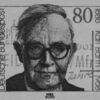
An email question from a reader of the blog: 𝑂𝑛𝑒 𝑡ℎ𝑖𝑛𝑔 𝐼 𝑎𝑚 𝑡𝑟𝑦𝑖𝑛𝑔 𝑡𝑜 𝑚𝑎𝑘𝑒 𝑠𝑒𝑛𝑠𝑒 𝑜𝑢𝑡 𝑜𝑓 𝑖𝑠 𝑡ℎ𝑒 𝐵𝑎𝑟𝑡ℎ𝑖𝑎𝑛 𝑖𝑑𝑒𝑎 𝑡ℎ𝑎𝑡 𝐽𝑒𝑠𝑢𝑠 𝐶ℎ𝑟𝑖𝑠𝑡 𝑖𝑠 “𝑔𝑟𝑎𝑐𝑒” 𝑒𝑚𝑏𝑜𝑑𝑖𝑒𝑑. 𝐼 𝑟𝑒𝑎𝑑 𝑦𝑜𝑢𝑟 𝑝𝑜𝑠𝑡𝑠 𝑎𝑏𝑜𝑢𝑡 𝑖𝑡. 𝑆𝑜 𝑛𝑜 𝑝𝑟𝑒𝑣𝑒𝑛𝑖𝑒𝑛𝑡 𝑔𝑟𝑎𝑐𝑒 𝑎𝑛𝑑 𝑛𝑜 𝑖𝑟𝑟𝑒𝑠𝑖𝑠𝑡𝑖𝑏𝑙𝑒 𝑔𝑟𝑎𝑐𝑒. 𝑊𝑒 ℎ𝑎𝑣𝑒 𝐽𝑒𝑠𝑢𝑠 𝑤ℎ𝑜 𝑖𝑠 𝐺𝑜𝑑’𝑠 𝑔𝑟𝑎𝑐𝑒. 𝐼𝑠 𝑡ℎ𝑎𝑡 𝑟𝑖𝑔ℎ𝑡? 𝑊ℎ𝑒𝑛 𝑡ℎ𝑒 𝐵𝑖𝑏𝑙𝑒 𝑠𝑎𝑦𝑠, “𝑏𝑦 𝐺𝑟𝑎𝑐𝑒 𝑦𝑜𝑢 ℎ𝑎𝑣𝑒 𝑏𝑒𝑒𝑛 𝑠𝑎𝑣𝑒𝑑…” 𝐼𝑠 𝑃𝑎𝑢𝑙 𝑗𝑢𝑠𝑡 𝑟𝑒𝑝𝑙𝑎𝑐𝑖𝑛𝑔 𝐽𝑒𝑠𝑢𝑠 𝑤𝑖𝑡ℎ 𝑡ℎ𝑒 𝑤𝑜𝑟𝑑 𝑔𝑟𝑎𝑐𝑒? 𝐶𝑎𝑛 𝑦𝑜𝑢 𝑝𝑙𝑒𝑎𝑠𝑒 ℎ𝑒𝑙𝑝 𝑚𝑒 𝑢𝑛𝑑𝑒𝑟𝑠𝑡𝑎𝑛𝑑 𝑡ℎ𝑖𝑠? My brief response: 𝐒𝐨, 𝐁𝐚𝐫𝐭𝐡 (𝐚𝐧𝐝 𝐨𝐭𝐡𝐞𝐫𝐬, 𝐉𝐮̈𝐧𝐠𝐞𝐥, 𝐓𝐅 𝐓𝐨𝐫𝐫𝐚𝐧𝐜𝐞), 𝐟𝐨𝐥𝐥𝐨𝐰𝐬 𝐚 𝐭𝐡𝐞𝐨𝐥𝐨𝐠𝐢𝐜𝐚𝐥 𝐚𝐜𝐭𝐮𝐚𝐥𝐢𝐬𝐦, 𝐰𝐡𝐢𝐜𝐡 𝐞𝐧𝐭𝐚𝐢𝐥𝐬 𝐚 “𝐛𝐞𝐢𝐧𝐠 𝐢𝐧 𝐛𝐞𝐜𝐨𝐦𝐢𝐧𝐠.” 𝐓𝐡𝐢𝐬…
Contra the Tradition Produced God of Natural Theology
Natural theology separates God from his Word, and in the Reformed context this separation requires that another mechanism be constructed in order for God to enact relationship with the world; i.e. through the 𝑑𝑒𝑐𝑟𝑒𝑡𝑢𝑚 𝑎𝑏𝑠𝑜𝑙𝑢𝑡𝑢𝑚, or through a determining decretal system that inter-links God’s power and being to the rest of the world all along keeping God untouched by the world or the creatures who inhabit it (all in an attempt to sustain the philosophically developed loci known as simplicity, immutability, impassibility, infinity, etc.). The problem, if not recognizable, is that in this ‘classical’ system of theology proper God is…
The Character of Barth’s Kantian and Feuerbachian Critique of the Metaphysical gods
Ludwig Feuerbach Karl Barth is often identified as a neo-Kantian, or just straight up Kantian in his theological orientation (and methodology). It seems too facile to me to maintain that Barth was somehow a slavish servant of Kant, especially materially. Maybe formally, Barth could be understood to be a Kantian in certain qualified ways. But in the air he breathed to be “Kantian” or neo-Kantian would be like saying that John Calvin et al. was an Aristotelian, or Scotist for that matter. The point being, often, formalities are not the all-encompassing thing in the theological project. Ultimately, what is at…
Life is Worth Living Before God in Christ: Against Suicide and Self-Destruction
He has made everything beautiful in its time. He has also set eternity in the human heart; yet no one can fathom what God has done from beginning to end. –Ecclesiastes 3:14 The Lord brings death and makes alive; he brings down to the grave and raises up. –I Samuel 2:6 Judas Iscariot Three decades ago now (to the year) I started struggling heavily with anxiety, depression, and spiritual warfare that was beyond me. It was this that the Lord used in my life to draw me to Him in very serious and sober ways. This struggle, in a very intense way (on a…
On Mormonism as a Gnostic-Arianism and its Theosis
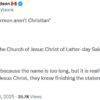
More engagement with a Mormon (a different one this time). On Mormonism as a Form of Gnostic Arianism No, it’s because the Mormon Jesus is equivocal with the Christian Jesus. In other words, the Mormon Jesus is not understood to be the second person of the Trinity (along with the Father and Holy Spirit), i.e., not ℎ𝑜𝑚𝑜𝑜𝑢𝑠𝑖𝑜𝑠 (of the same exact being) with the Father and the Holy Spirit. The Mormon Jesus, at best, is a philosophical demiurge deployed by the Father (who alone is God) to point the LDS to their inherent need to be freed from the physical…