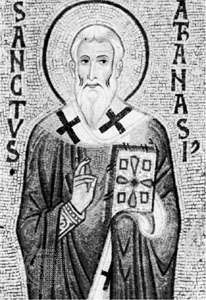
Athanasius thought of sin and the fractured life with God, as a dissolution. Annihilationism has been in the news lately (because of Kirk Cameron’s recent disclosure that he now holds to the conditional immortality or annihilationist position in regard to hell). There is a sense that at the last judgment those spiritually outside of Christ will finally be dissolved; we could even say, annihilated. But the fact of the matter remains, according to Scripture’s teaching: the final annihilation of fallen human beings will be an everlasting existence in the midst of a conscious annihilation. Such that, the individual person will exist in the dissolution they currently inhabit now—apart from union with Christ—but like a wandering star for whom the black darkness has been reserved forever, they will be fully “alive” in the midst of their annihilated being. It behooves folks to come to Christ whilst there is still time. Maranatha
And yet, there indeed remains hope eternal in Jesus Christ. Athanasius, as noted, maintained that to be out of union with the triune God entails that the human existence, left to itself, would fully cease to exist—again, not consciously, but in its dissolved status—indeed, this is the status fallen humanity currently inhabits (whilst fully conscious). The difference at the final judgment, is that those who die outside of Christ’s righteousness for them, will become fully aware of the fallen statuses they have been inhabiting their whole respective existences now. At that time, the veil will be removed, and the reality will come full weight; whether that be for those spiritually in Christ or those outside. Again, it behooves people to leave this current world-iteration in full union with Christ; simply by saying Yes to Jesus’ offer of eternal life in Himself for you, for us.
Below, Athanasius details the various notes I have been engaging with in the aforementioned. He makes sure to give the fallen, those being currently destroyed (see I Corinthians 1:18), those living in a dissolving self, the Good News of God in Jesus Christ. He makes sure to end on the elevated reality that God has not in fact left us to our vanishing selves, and instead, in a ‘wonderful exchange,’ given us the very weight and substance of His life that He alone possesses; the only eternal life around.
. . . Yet, true though this is, it is not the whole matter. As we have already noted, it was unthinkable that God, the Father of Truth, should go back upon His word regarding death in order to ensure our continued existence. He could not falsify Himself; what, then, was God to do? Was He to demand repentance from men for their transgression? You might say that that was worthy of God, and argue further that, as through the Transgression they became subject to corruption, so through repentance they might return to incorruption again. But repentance would not guard the Divine consistency, for, if death did not hold dominion over men, God would still remain untrue. Nor does repentance recall men from what is according to their nature; all that it does is to make them cease from sinning. Had it been a case of a trespass only, and not of a subsequent corruption, repentance would have been well enough; but when once transgression had begun men came under the power of the corruption proper to their nature and were bereft of the grace which belonged to them as creatures in the Image of God. No, repentance could not meet the case. What — or rather Who was it that was needed for such grace and such recall as we required? Who, save the Word of God Himself, Who also in the beginning had made all things out of nothing? His part it was, and His alone, both to bring again the corruptible to incorruption and to maintain for the Father His consistency of character with all. For He alone, being Word of the Father and above all, was in consequence both able to recreate all, and worthy to suffer on behalf of all and to be an ambassador for all with the Father.[1]
[1] Athanasius, On the Incarnation, §7, 32-3.