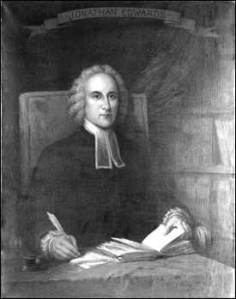
A word from American theologian par excellence, Jonathan Edwards, on the beauty of the triune God:
 It is unreasonable to think otherwise, than that the first foundation of a true love of God, is that whereby He is in Himself lovely, or worthy to be loved, or the supreme loveliness of His nature. This is certainly what makes Him chiefly amiable. What chiefly makes a man, or any creature lovely, is his excellency; and so what chiefly renders God lovely, and must undoubtedly be the chief ground of true love, is His excellency. God’s nature, or the Divinity, is infinitely excellent; yea it is infinite beauty, brightness, and glory of itself. But how can that be true love of this excellent and lovely nature, which is not built on the foundation of its true loveliness? How can that be true love of beauty and brightness which is not for beauty and brightness’ sake?[1]
For our purposes we will ignore the implicit analogia entis procedure of negative knowledge of God in Edwards’ above rumination, and simply focus on his conclusions.
Along with Edwards I think we need to ‘Make the Beauty of God Great Again’ (MBGGA). Not that we can predicate anything of God, but indeed, we must bear witness to the reality that is in fact lovely, beautiful. In the above statement Edwards refers to brightness as a synonym of beauty with reference to God. What this conjures for me is Genesis 1, and the Light of God’s Grace made known at God’s first Word: ‘In the beginning God created the heavens and earth.’ God’s Light is the primordial Light of the world, indeed the Light that will finally make the Sun and Moon no longer necessary in the Eschatological Light of the Son of Man as His presence in the abode of the Father by the Holy Spirit is unquenchably diffuse throughout the New Heavens and Earth, the Heavenly Zion as that spans the expanse of a de-futilized creation.
Further, implicit and at the base of God’s life for Edwards is that God’s beauty is fitting in the sense that God is a perichoretic relationship of interpenetrating filial and pneumic subject-in-being onto-relating Self-givenness one in the other eternal life. But it is precisely this, for Edwards, at least in my riff of him, that God’s love is indeed beautiful; that is, that God is not a philosophical monad, but instead a relationship of eternal persons in koinonial singular being as Father, Son, and Holy Spirit. As such it is the mysterium Trinitatis that is deserving of all praise and worship. The mystery of God’s eternal life to be basked in by His creatures in Christ, in a doxological wash of bliss and beholdenness. The beauty of the triune God becomes the purpose of the human ensouled body. It is here, in this magnificent beauty of the Father, the Son in His bosom, hovered over by the Holy Spirit that the people recreated in His image in the face of the Son, Jesus Christ, that the sons of God long for; indeed, the revealing of the sons of God as they are unfurled from their bodies of death, and finally brought into the consummate participatory Beatific vision of the triune God. And for the Christian why wait? Even though our bodies of death attempt to keep us clinging to the dust of our earthly origin, the excellency of God’s life in us raises up over and again in the intercession the Son continuously makes for those who will inherit eternal life.
Amen.
[1] Jonathan Edwards cited by Nick Needham, 2000 Years of Christ’s Power: The Age of Enlightenment and Awakening 18th Century, Volume 5 (Great Britain: Christian Focus Publications Ltd., 2023), 364.