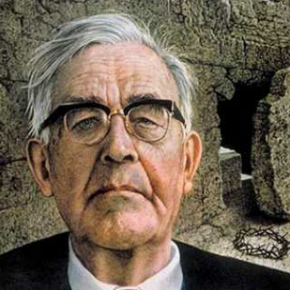
Karl Barth develops what he calls, The Three Forms of the Doctrine of Reconciliation, in Church Dogmatics IV/1 §58. The first form is with reference to the ground of Christ’s person; i.e., the second person of the Trinity, the eternal Logos, the Son of God. As many of the early church fathers understood without the ground of Jesus’ person being the triune God in the eternal Logos, there could be no salvation for the weary wayfarers of a fallen humanity. Justification before and with God required that the “bridge” between the Holy God and the fallen humanity be God Himself; for He alone could bear the wages of sin in His own assumed humanity in the flesh and blood of the man from Nazareth, Jesus Christ. If Christ was not God’s pleroma (fullness) for us all he would have been was some type of exemplar to ostensibly show a way to God; a way of works-righteousness, with the hope that fallen humanity, like the Christ consciousness, could elevate itself to God’s throne room based on their own merits; albeit, infused with an abstract power (or created grace) provided for by God—of the type that Jesus as the exemplar modeled for us in his own humanity. This might be one expression of attempting to develop a soteriology outwith Jesus being fully God. Genuine Christian salvation required that God reach down to us, become us, and then ascend with us in the garb of his full humanity whereby we might be participants in the triune holiness forevermore; indeed, as the Son has always already constituted that in His inner life with the Father by the Holy Spirit.
Barth writes:
The first is that in Jesus Christ we have to do with very God. The reconciliation of man with God takes place as God Himself actively intervenes, Himself taking in hand His cause with and against and for man, the cause of the covenant, and in such a way (this is what distinguishes the even of reconciliation from the general sway of providence and universal rule of God) that He Himself becomes man. God became man. That is what is, i.e., what has taken place, in Jesus Christ. He is very God acting for us men, God Himself become man. He is the authentic Revealer of God as Himself God. Again, He is the effective proof of the power of God as Himself God. Yet again. He is the fulfiller of the covenant as Himself God. He is nothing less or other than God Himself, but God as man. When we say God we say honour and glory and eternity and power, in short, a regnant freedom as it is proper to Him who is distinct from and superior to everything else that is. When we say God we say the Creator and Lord of all things. And we can say all that without reservation or diminution of Jesus Christ—but in a way in which it can be said in relation to Him, i.e., in which it corresponds to the Godhead of God active and revealed in Him. No general idea of “Godhead” developed abstractly from such concepts must be allowed to intrude at this point. How the freedom of God is constituted, in what character He is the Creator and Lord of all things, distinct from and superior to them, in short, what is to be understood by “Godhead,” is something which—watchful against all imported ideas, ready to correct them and perhaps to let them be reversed and renewed in the most astonishing way—we must always learn from Jesus Christ. He defines those concepts: they do not define Him. When we start with the fact that He is very God we are forced to keep strictly to Him in relation to what we mean by true “Godhead.”[1]
Significantly, for Barth, it is because Jesus is truly God, that He can genuinely reveal God to humanity; indeed, to the very humanity He assumes in the womb of Mary. This is the only way, as Barth rightly presses, that salvation might actually obtain for a fallen humanity. That is, for God to be brought into humanity, in Christ, and for humanity to be brought into God, by the grace of Christ’s life for us.
In synopsis: The above passage from Barth could be taken as the guiding premise of his whole theological offering. Without salvation, without reconciliation being fully God and fully man, in the hu[man]ity of Jesus Christ, for Barth, and more importantly, for Holy Scripture, there is no eternal life to be had; there is no salvation to be enjoyed; and there is no vision of God to be experienced. This is the all or nothing reality that fortifies not just Barth’s Gospel, but the Gospel of Christ itself as revealed by Himself in the Father by the Holy Spirit.
[1] Karl Barth, Church Dogmatics IV/1 §58 [129] The Doctrine of Reconciliation: Study Edition (London: T&T Clark, 2010), 124–25.