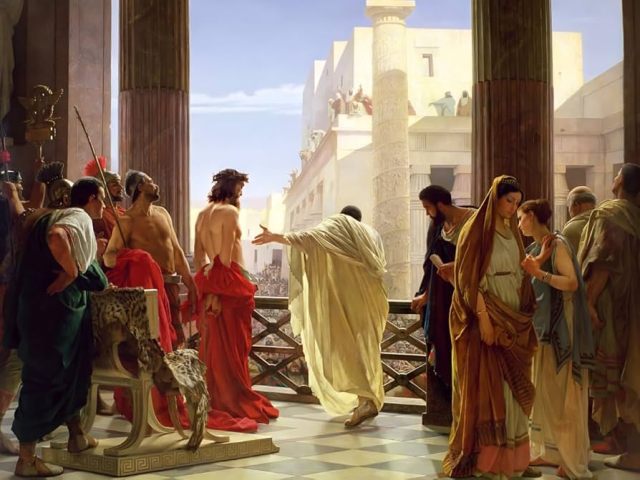
Not only is Jesus Very God, but he is also Very Man. This is the Nicene-Constantinopolitan-Chalcedonian settlement in regard to the hypostatic union of Jesus person’ being both fully God, at His very being, and fully human as the ground of His being the Man from Nazareth in the Galilee. This post is meant to dovetail with the other side of this union where we looked at the way that Barth treated the personhood of Jesus Christ as ‘Very God.’ But without Very God, the Son of God, becoming Very man, we would of all people be most to be pitied. This is the stuff of the Gospel itself.
If God did not freely elect to become human, as both the electing God and the elected man, then there would be no way into reconciliation with the inner and triune life of God. We could not become partakers and thus participants in the divine nature if God did not first become us in Christ. As any good Bible reader understands, fallen humanity left to its own devices only remains in a vicious circle of self-love; a life constrained by the love of self, and its base desires, rather than being constrained by the love of God in Christ and His holiness. It took God to invade our war torn and dead sub-humanity, and re-create it such that the fallen person can finally be elevated into the throne-room of God’s life as the Son ascends with us back to the glory He has always already eternally shared with the Father in the bond of the Holy Spirit. All of this to say: the ‘man’ (human) part of the Gospel is just as important as the God part, insofar that without God becoming us it would be absolutely impossible for us to pierce into His inner and triune life and be saved. So, the man part, funded by the God part, both hypostatically united in the singular person of Jesus Christ is in fact the Euaggelion (Gospel). And for this we should be full of gratitude and worship to our Father who is in heaven.
Barth writes:
This means primarily that it is a matter of the Godhead, the honour and glory and eternity and omnipotence and freedom, the being as Creator and Lord, of the Father, Son and Holy Spirit. Jesus Christ is Himself God as the Son of God the Father and with God the Father the source of the Holy Spirit, united in one essence with the Father by the Holy Spirit. That is how He is God. He is God as He takes part in the even which constitutes the divine being.
We must add at once that as this One who takes part in the divine being and event He became and is man. This means that we have to understand the very Godhead, that divine being and event and therefore Himself as the One who takes part in it, in the light of the fact that it pleased God—and this is what corresponds outwardly to and reveals the inward divine being and event—Himself to become man. In this way, in this condescension, He is the eternal Son of the eternal Father. This is the will of this Father, of this Son, and of the Holy Spirit who is the Spirit of the Father and the Son. This is how God is God, this is His freedom, this is His distinctness from the superiority to all other reality. It is with this meaning and purpose that He is the Creator and Lord of all things. It is as the eternal and almighty love, which He is actually and visibly in this action of condescension. This One, the One who loves in this way, is the true God. But this means that He is the One who as the Creator and Lord of all things is able and willing to make Himself equal with the creature, Himself to become a creature; the One whose eternity does not prevent but rather permits and commands Him to be in time and Himself to be temporal, whose omnipotence is so great that He can be weak and indeed impotent, as a man is weak and impotent. He is the One who in His freedom can and does in fact bind Himself, in the same way as we all are bound. And we must go further: He, the true God, is the One whose Godhead is demonstrated and plainly consists in essence in the fact that, seeing He is free in His love, He is capable of and wills this condescension for the very reason that in man of all His creatures He has to do with the one that has fallen away from Him, that has been unfaithful and hostile and antagonistic to Him. He is God in that He takes this creature to Himself, and that in such a way that He sets Himself alongside this creature, making His own penalty and loss and condemnation to nothingness. He is God in the fact that He can give Himself up and does give Himself up not merely to the creaturely limitation but to the suffering of the human creature, becoming one of these men, Himself bearing the judgment under which they stand, willing to die and, in fact, dying the death which they have deserved. That is the nature and essence of the true God as He has intervened actively and manifestly in Jesus Christ. When we speak of Jesus Christ we mean the true God—He who seeks His divine glory and finds that glory, He whose glory obviously consists, in the fact that because he is free in His love He can be and actually is lowly as well as exalted; He, the Lord, who is for us a servant, the servant of all servants. It is in the light of the fact of His humiliation that on this first aspect all the predicates of His Godhead, which is the true Godhead, must be filled out and interpreted. Their positive meaning is lit up only by this determination and limitation, only by the fact that in this act He is this God and therefore the true God, distinguished from all false gods by the fact that they are not capable of this act, that they have not in fact accomplished it, that their supposed glory and honour and eternity and omnipotence not only do not include but exclude their self-humiliation. False gods are all reflections of a false and all too human self-exaltation. They are all lords who cannot and will not be servants, who are therefore no true lords, whose being is not a truly divine being.
The second christological aspect is that in Jesus Christ we have to do with a true man. The reconciliation of the world with God takes place in the person of a man in whom, because He is also true God, the conversion of all men to God is an actual event. It is the person of a true man, like all other men in every respect, subjected without exception to all the limitations of the human situation. The conditions in which other men exist and their suffering are also His conditions and His suffering. That he is very God does not mean that He is partly God and only partly man. He is altogether man just as He is altogether God—altogether man in virtue of His true Godhead whose glory consists in His humiliation. That is how He is the reconciler between God and man. That is how God accomplishes in Him the conversion of men to Himself. . ..[1]
Very meaty stuff!
Without getting too distracted let me lift up one aspect of this, particularly as found in the second paragraph above. Some critics might latch onto the fact that Barth writes, “. . . the conversion of all men to God is an actual event.” They might claim that this makes Barth a dogmatic universalist (or maybe some Christian universalists might want to take this in the positive from Barth). But that would be to miss Barth’s theology. Barth has just got done communicating that ‘the man’ Jesus Christ is the conversion of God for all of humanity in actuality. Even so, whilst this christological objectivism is rightly present in Barth, this should not lead the reader to imagine that Barth is operating from some type of Aristotelian theory of causation; to the contrary. Barth’s primary focus is on the primacy of Christ’s archetypal humanity as the humanity ‘converted’ to God. And within this, it can be (and should be) explicated that for Barth’s theology this entails all of humanity after Christ’s. So, there is a universalist aspect to the incarnation and its implications for Barth, just as there is for the Apostle Paul. But it would be wrong and foreign (to Barth’s total theology) to conclude that this necessarily leads to all of humanity subjectively bowing the knee to Christ as their Savior. This freedom in Christ for God has now been recreated in God’s freedom for us in Jesus Christ. But it is still required that by the power of the Holy Spirit a person says ‘Yes’ to God, from God’s ‘Yes and amen’ for them in Christ, in order to become full participants in the actual humanity of the Godman, Jesus Christ. In other words, the way of salvation has been ordained for all of humanity in and from Christ’s humanity. But the lost person must still recognize this reality and finally acknowledge (repent in Christ’s repentance for them) that without them echoing Christ’s yes and amen for them that they will be left out on the shadow-side of God’s lefthand of final judgment. Which in the end remains as mysterious as the first fall of humanity in Adam and Eve’s rebellion to God’s Word.
[1] Karl Barth, Church Dogmatics IV/1 §58 [130–31] The Doctrine of Reconciliation: Study Edition (London: T&T Clark, 2010), 125–26.